
 オンライン
オンライン 採用情報
採用情報 プレゼント
プレゼント
Delicious, Beautiful, and Good for Your Body
Kagoshima Tea
If you drive around Kagoshima, you’ll likely notice tea fields scattered throughout the landscape. There is a good reason—Kagoshima is Japan’s number one tea-producing region.* Blessed with a warm climate and cultivated using distinctive growing methods, Kagoshima tea is renowned for its delicious flavor. Here, we explore the secrets behind its popularity and why it is loved by people across Japan.
*Based on crude tea production volume in 2024.
If you drive around Kagoshima, you’ll likely notice tea fields scattered throughout the
landscape. There is a good
reason—Kagoshima is Japan’s number one tea-producing region.* Blessed with a warm climate
and cultivated using distinctive growing methods, Kagoshima tea is renowned for its delicious flavor.
Here, we
explore the secrets behind its popularity and why it is loved by people across Japan.
*Based on crude tea production volume in 2024.
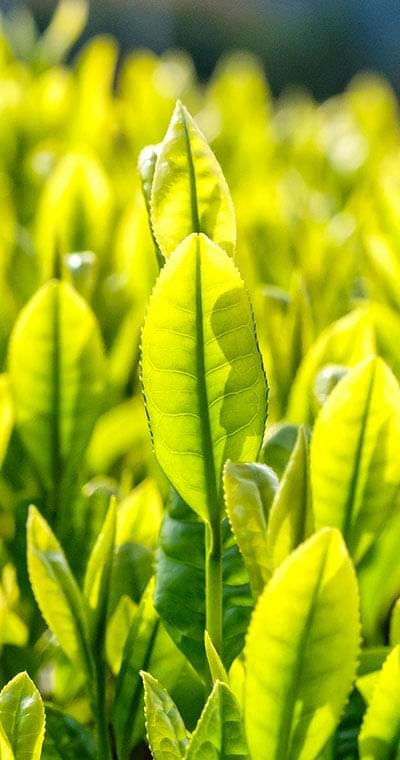
Subtropical Kagoshima,
Home of Japan’s First Tea
Harvest of
the Year
In Subtropical Kagoshima, where winters are mild and spring arrives early, Japan’s
first flush of tea
is harvested each year. As April approaches, tea fields spread across the prefecture turn deep green,
signaling the arrival of spring.
The first flush, known as shincha or ichibancha, grows for about
five
months from November through March, absorbing abundant nutrients from the soil after its winter
dormancy. This is why it is so flavorful, rich in nutrients, and eagerly awaited by so many
people.
Kagoshima tea is characterized by its refreshing aroma and rich umami. When brewed, it reveals a deep,
vivid green color with remarkable depth and beauty.
Subtropical Kagoshima,
Home of Japan’s
First Tea Harvest of
the Year
In Subtropical Kagoshima, where winters are mild and spring arrives early, Japan’s first flush of tea is
harvested each year. As April approaches, tea fields spread across the prefecture turn deep green,
signaling the arrival of spring.
The first flush, known as shincha or ichibancha, grows for about
five months from November through March, absorbing abundant nutrients from the soil after its winter
dormancy. This is why it is so flavorful, rich in nutrients, and eagerly awaited by so many
people.
Kagoshima tea is characterized by its refreshing aroma and rich umami. When brewed, it
reveals a deep, vivid green color with remarkable depth and beauty.
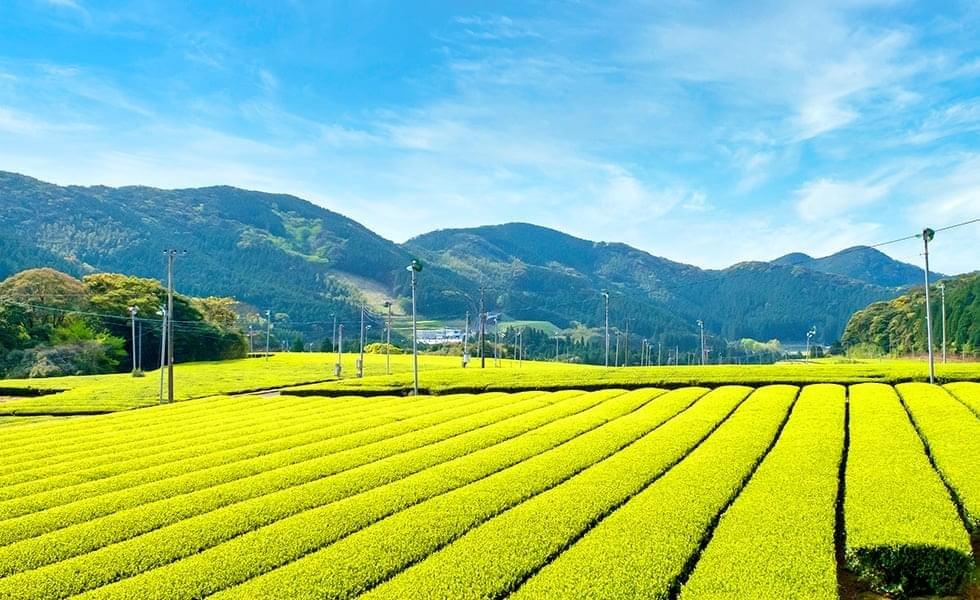
Leveraging Mechanization and Unique Geographical Features, Kagoshima Has Become Japan’s Leading Tea-Producing Region.
Although Kagoshima now ranks first in Japan for crude tea production (2024), it was
actually a latecomer, only beginning to actively develop its tea industry in the 1960s.
Since then, its
growth has been remarkable. By preparing farmland in advance—leveling and improving the land to enable
mechanization—tea cultivation became far more efficient, leading to a dramatic increase in
production.
Kagoshima’s unique geography has also played a major role. With many islands and a long
north–south stretch—from Tokunoshima in the south to Tanegashima, Yakushima, and up to Izumi on the
mainland—the region can extend its cultivation period.
Harvesting begins with the first flush in early
April and continues uninterrupted through the second and third flushes, all the way to the fourth flush in
mid-August. This extended harvesting season is one of the reasons why Kagoshima, despite having a smaller
cultivation area than Shizuoka, has become Japan’s leading producer of crude tea.
Leveraging Mechanization and
Unique Geographical
Features,
Kagoshima Has Become Japan’s Leading Tea-Producing Region.
Although Kagoshima now ranks first in Japan for crude tea production (2024), it was
actually a latecomer, only beginning to actively develop its tea industry in the 1960s.
Since then, its
growth has been remarkable. By preparing farmland in advance—leveling and improving the land to enable
mechanization—tea cultivation became far more efficient, leading to a dramatic increase in
production.
Kagoshima’s unique geography has also played a major role. With many islands and a long
north–south stretch—from Tokunoshima in the south to Tanegashima, Yakushima, and up to Izumi on the
mainland—the region can extend its cultivation period.
Harvesting begins with the first flush in early
April and continues uninterrupted through the second and third flushes, all the way to the fourth flush in
mid-August. This extended harvesting season is one of the reasons why Kagoshima, despite having a smaller
cultivation area than Shizuoka, has become Japan’s leading producer of crude tea.


Cultivation Methods That Enhance Flavor and Brewing Techniques That Are Good for Your Body
That’s not the only distinctive feature of Kagoshima tea cultivation. About a week
before harvesting, the entire tea field is covered with black nets. This is a special technique used
to produce more flavorful tea.
By covering the fields, about 70–80% of sunlight is blocked. In response, the tea plants increase
their chlorophyll
content. As a result, the leaves become a deeper green, and when brewed, the tea reveals a rich,
beautifully vivid green
color.
Cultivation Methods That Enhance Flavor and Brewing Techniques That Are Good for Your Body
That’s not the only distinctive feature of Kagoshima tea cultivation. About a week before harvesting,
the entire tea field is covered with black nets. This is a special technique used to produce more
flavorful tea.
By covering the fields, about 70–80% of sunlight is blocked. In response, the tea plants increase their
chlorophyll content. As a result, the leaves become a deeper green, and when brewed, the tea reveals a
rich, beautifully vivid green color.
With Its Wide Variety,
Kagoshima Tea Can Be Enjoyed in
Many Ways Beyond Simply Drinking.
Kagoshima tea is also distinguished by its wide range of varieties compared to other
regions. While
the Yabukita
cultivar accounts for over 80% of tea production nationwide, Kagoshima makes the most of its warm
climate to cultivate
other varieties such as Yutakamidori and Saemidori in abundance.
In addition, collaborations with hotels within the prefecture offer guests seasonal lunch menus
featuring not only
sencha, but also a variety of teas such as matcha and hojicha. Tea can be enjoyed not just as a
beverage, but as an
ingredient in both Western and Japanese cuisine.
Overseas, matcha is currently experiencing a boom, with more people enjoying it casually—especially in
sweets and
desserts.
Kagoshima tea is no longer just for drinking; it can be enjoyed in a wide range of ways, from cuisine
to sweets, and
is gaining attention around the world. Delicious, beautiful, and good for your body—experience the tea
of Subtropical
Kagoshima.
With Its Wide Variety,
Kagoshima Tea Can Be Enjoyed in
Many Ways Beyond Simply Drinking.
Kagoshima tea is also distinguished by its wide range of varieties compared to other
regions. While the Yabukita cultivar accounts for over 80% of tea production nationwide, Kagoshima makes
the most of its warm climate to cultivate other varieties such as Yutakamidori and Saemidori in
abundance.
In addition, collaborations with hotels within the prefecture offer guests seasonal lunch menus
featuring not only sencha, but also a variety of teas such as matcha and hojicha. Tea can be enjoyed not
just as a beverage, but as an ingredient in both Western and Japanese cuisine.
Overseas, matcha is currently experiencing a boom, with more people enjoying it casually—especially in
sweets and desserts.
Kagoshima tea is no longer just for drinking; it can be enjoyed in a wide range of ways, from cuisine to
sweets, and is gaining attention around the world. Delicious, beautiful, and good for your
body—experience the tea of Subtropical Kagoshima.
